L7-50153: Early detection and management of important grapevine diseases (RESENSE-VITIS)


Project description
Viticulture is one of the most profitable agricultural industries in Slovenia, with approximately 16.000 ha of vineyards entered in the register of grape and wine producers. In a year, 800.000 to 1.000.000 litres of wine are produced. Optimal implementation of protection measures has a significant impact on the economics of production.
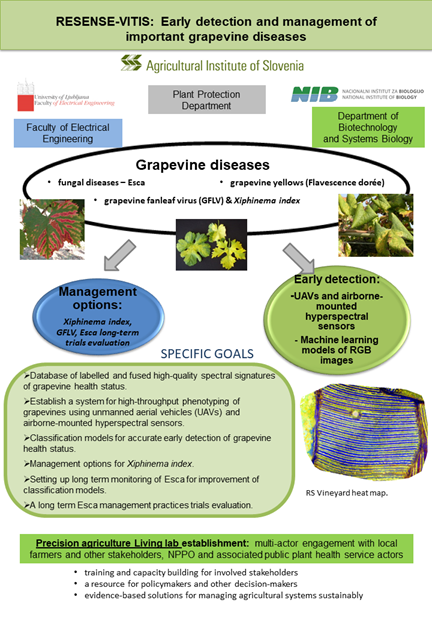
Grapevines are capable of sustained production for 30 years or more, their long lifespan depends on nutrition and protection against diseases and pests. Most grapevine diseases are caused by phytoplasmas, fungi, and viruses. Among these, most damage is caused by grapevine yellows (Flavescence dorée), grapevine fanleaf virus (GFLV) and the group of fungal diseases known as esca. All of these lead to severe yield losses and plant death. Two of these diseases are being spread by vectors grapevine yellows by the American grapevine leafhopper, (Scaphoides titanus, which are controlled with insecticides) and GFLV by the nematode Xiphinema index. The effectiveness of such control measures, however, is limited and disease foci remain present or spread. An example is the rapid spread of grapevine yellows in the wider area of Ormož, leading to the adoption of an action plan with measures to control grapevine yellows.
Regardless of the chosen plant disease management method, preventive measures remain crucial. Detection of the disease is of utmost importance, as there is no real cure for infected plants, and can only be removed from the vineyard. Therefore, it is necessary to assess the health status of all plants in an individual vineyard, which is time consuming and costly. Visible signs of infections are not necessarily specific to a particular disease, so molecular analyses are applied, further increasing the effort and cost. These limitations can be circumvented by using spectral imaging to obtain spatially accurate data on the health status of plants, before the appearance of visible symptoms. This allows for timely and targeted action.
Objectives
The general aim of the proposed research project is to facilitate early detection of selected grapevine diseases, and distinguish them from abiotic stress. In order to achieve that goal, a better understanding of the diseases’ influence on grapevine leaf area optical properties in relation to changes induced by plant seasonal development is needed. In this study we will work with vineyards from two vine-growing regions in Slovenia, thus encompassing a wider range of climate and geological conditions, which will lead to a better generalizability of developed machine learning classification models. Furthermore, because esca is a complex disease, which can remain hidden for years, we will establish a long-term monitoring program. This program will be maintained within the expert integrated plant management framework.
Specific objectives of the proposed project are:
- Establish a database of labelled and fused high-quality spectral signatures and other measurements for further research of grapevine health status.
- Establish a system for high-throughput phenotyping of grapevines using unmanned aerial vehicles (UAVs) and airborne-mounted hyperspectral sensors.
- Develop classification models for accurate early detection of grapevine health status.
- Development of management methods for Xiphinema index.
- Setting up long term monitoring of Esca for further improvement of the classification models developed during this project.
- Follow health status of long term esca management trials.
Work programme
The proposed project comprises six interconnected thematic work packages (WP1-6) and a project management WP7.
Work package 1 – Vineyard selection and plant health assessment protocols: The appropriate vineyards will be selected on the basis of the knowledge and experience of KGZS Nova Gorica and KGZS Maribor. These vineyards will represent a selection of red and white varieties with the selected diseases being present in previous years. We will establish disease evaluation protocols for all three diseases studied in the project.
Work package 2 – Grapevine fanleaf virus (GFLV): The activities of WP2 will include disease detection and remote sensing. These will be limited in the Primorska region where the X. index nematodes (GFLV vector) are distributed. We will also test various methods for X. index management. These experiments will be carried out in a greenhouse or microplots, where we will test the activity of bionematicides, as well as soil fungi and bacteria from the KIS collection. These fungi and bacteria will be tested for their nematicidal activity.
Work package 3 – Grapevine yellows: Visual field inspections for GY will be carried out in selected vineyards. Potentially infected vines will be confirmed by molecular analyses in cooperation with NIB. As part of the project, we will prepare several model simulations of the spread of golden grapevine yellows and apply them in Štajerska and Primorska regions. We will select established disease spread models and conduct an analysis of the potential GY spread under various factors that affect the spread of its vector. These factors include the vector population, susceptibility of the vines to infection, number of infected vines and their removal as part of the implementation of phytosanitary measures, vineyard density in the area, among others.
Work package 4 – Esca: The work will take place in vineyards scheduled for felling or restoration after autumn 2023. We will conduct an evaluation of Esca in these vineyards, which will provide reliable data for the development of models using hyperspectral images. Due to the nature of Esca, we will monitor the course of this disease in the selected vineyards even after the end of this project, as part of the expert work carried out at KIS, KGZS-Nova Gorica and KGZS-Maribor.
Work package 5 – Remote sensing: The main flow of information goes towards WP5, where we will develop classification models based on the results of plant health analyses from previous WPs. By capturing hyperspectral data with drones and an aeroplane in a time series, we will be able to develop methods for early disease detection. In collaboration with the Artificial Intelligence Laboratory (FE, UNI-LJ), we will research methods for determining the health status of grapevines using inexpensive classic RGB sensors, which are in use on many UAVs.
Work package 6 – Communication and dissemination: Within the framework of WP6, we will disseminate project content and results through institutional communication channels (e.g. website) and papers in peer-reviewed journals. We will also establish a Living Laboratory for precision agriculture, which will further ensure the expansion of the use of remote sensing, education of target groups and closer cooperation between stakeholders from different agricultural disciplines.
Work package 7 – Project management: WP7 is intended to coordinate activities within the partnership by closely monitoring the work progress and the results achieved.
Results
The results of the project will be directly applicable to real world scenarios. We will test new, non-chemical methods to mitigate the impact of the diseases, combined with precision agriculture approaches and early detection systems. According to the expected results of the project, it will be possible to improve integrated grape production and reduce the negative impact on local biodiversity and groundwater. The developed machine learning models will be able to be applied to other vineyards, as the inclusion of two wine-growing regions will increase the generalizability of the developed models. The spectral libraries that will be established within the framework of this project will encourage further development of models for the determination of other vine diseases. Newly developed disease management will be able to be used or lead to the development of new products. A Precision agriculture Living Lab will also be established, which will facilitate implementation of remote sensing, further education activities, and enhance cooperation between different stakeholders. By combining multi-year work outside the time limits of this research project, we will gain better understanding of esca and further improve the reliability of the methods developed in the project.
Key results (reports) will be published later.
Summary of project implementation in 2024
We have completed the selection of all vineyards planned for monitoring in the project, from two wider wine-growing regions (Primorska: Slovenska Istra and Kras, Goriška Brda; and Štajerska: Jeruzalem). The vineyards are a representative mix of white and red varieties. The researched diseases are present or have occurred in the past in the selected vineyards or their surroundings. We have prepared internal field work protocols to assess the health status of plants, which we used in all field inspections. Imaging of all vineyards was carried out with hyperspectral and RGB systems in a time series (once a month during the growing season) with an aircraft and drones. Imaging and visual inspections of vines were completed on the same day or the same week, and the obtained images were processed at the end of growing season. We carried out sampling of selected vines and molecular analyses for the detection of FD and GFLV. The presence of X. index nematodes in selected vineyards was determined in the scope of preparations for a larger pot experiment for X. index (GFLV vector) management. We began evaluating various fungal strains and bacterial isolates, of which the most promising will be selected for pot experiment to test nematicidal effects against X. index.
Partner organisations: 0105 – National Institute of Biology; 1538 – University of Ljubljana, Faculty of Electrical Engineering